




I actually made this a couple weeks ago, for New Year's Day, but I haven't had a chance to post about it till now. Chinese "red-braised" beef is one of my ultimate comfort foods. My grandmother use to make the best I have ever tasted, although my mom's is pretty darn good too. I had my grandma teach me how to make this and a few other favorite dishes a number of years ago, following her to the grocery store and attempting to keep track of her measurements.
It's basically a large, tough cut of beef braised in a mixture of soy sauce and other liquids until tender. The soy sauce is what gives it the "red" color (although some will argue it's really brown, but whatevs).
It's basically a large, tough cut of beef braised in a mixture of soy sauce and other liquids until tender. The soy sauce is what gives it the "red" color (although some will argue it's really brown, but whatevs).
Even with a pressure cooker, this dish is pretty time-consuming, so it's best cooked at least a day ahead of time.
Ingredients
3-6 lbs beef boneless shank or chuck (or combination of the two), left in large pieces
1 lb beef tendon (optional)
1/2 c. soy sauce
1/4 c. dark mushroom soy sauce
1/4 c. Chinese rice wine (can also substitute mirin or even whisky in a pinch)
3-4 cloves garlic
3 scallions, cut into 3-4 pieces
4-5 whole star anise pods
1/2 tsp whole Szechwan peppercorns
1/4 tsp black peppercorns
Up to 1/2 c. water, as needed
Directions
1. In a large pressure cooker, add all ingredients. If you like, you can tie up the star anise and peppercorns into a small sachet of cheesecloth or put them in a tea ball to make it easier to fish them out later. However, you'll be straining the liquid at the end, so it's not completely necessary. The liquid in the pot should come about halfway up the level of meat. Add water, as needed, but try not to add more than 1/2 cup.
2. Close the lid and heat according to you pressure cooker directions. Pressure-cook for 1-2 hours, until meat is very tender, almost (but not quite) falling apart. If you're also using the tendon, that may take longer, so you may need to remove the meat and keep cooking the tendon separately. Alternately, if you don't have a pressure cooker, you can do this in a large Dutch oven over low heat for 3-4 hours.
3. Once everything is cooked, separate the meat & tendon from the liquid, and then strain the liquid into a large measuring cup or bowl. The amount of liquid you end up with vary, but I yielded roughly a quart of liquid from 6 lbs of meat. You will likely have much less if you did not use a pressure cooker.

4. If you have the time, cool the liquid down in the refrigerator or freezer until the fat separates and solidifies. Skim this fat off and discard.The meat and tendon is also much easier to handle if you allow it to cool for several hours, covered, in the refrigerator. I usually wait until it is cooled, cut only what I'll need into 1/4-1/2 inch slices, then reheat.
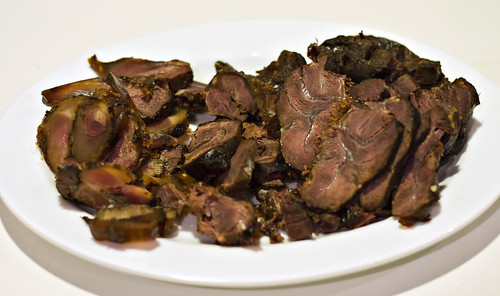
Here's a pic of the meat and tendon, after it has been sliced.
The meat and liquid also freeze well separately. My mom used to freeze the liquid in plastic storage containers and then transfer the blocks to ziploc bags. Once defrosted, it makes for a quick easy dinner.
Once your meat is cooked, there are a number of different things you can do with it. The most common is to make beef noodle soup by take the cooking liquid and turn it into a broth, and then adding beef and noodles. It's sort of like Vietnamese pho, but with different flavor profiles.
To make the broth, pour 2 cups braising liquid into a large stockpot. Add 1 quart of low-sodium chicken stock (I use Pacific Natural Foods organic chicken broth). Don't worry, the liquid has plenty of beef-y flavor and you'll never know the difference. Add one can of diced tomatoes (liquid and all), and bring to a boil. Add about 1/2 cup of chopped scallions just before turning off the heat. You can also add napa cabbage or fresh spinach to the soup, if you want to get a little veg in there.
To serve, place your desired amount of freshly boiled Chinese noodles and sliced meat in a large bowl. Ladle the hot soup over it and eat immediately.
You could also make green onion pancakes and serve the meat with that. I've previously posted the recipe on my other blog.
Notes
I know that 3-6 lbs of meat sounds a bit broad, but it's the same amount of work to make 3 lbs as it is to make 6 lbs, so it doesn't hurt to make extra and freeze half. I usually cook somewhere around 3-4 lbs of meat. I realize that still sounds like a lot, but it does cook down quite a bit and we don't mind leftovers around here. ;) This was the first time I made 6 lbs because I was feeding six people instead of three, and we definitely had plenty to spare.
Also, I'm sure a lot of you read "tendon" in the ingredients list and made a face. But honestly, that's probably my favorite part of this dish. It's definitely not for everyone since the texture, once cooked, is fairly gelatinous, but if you can get past that, it's really fabulous. You'll more than likely have to go to an Asian grocery store to find it though. In the past, I've gone to meat markets and asked about it only to have butchers look at me all cross-eyed.
As for the other cuts, I also bought large, 2-lb pieces of beef shank at the Chinese grocery store, but if you can't find those, the smaller, bone-in cross cut pieces you find at the regular grocery store will work. Or a large chuck roast is good too.
As for the other cuts, I also bought large, 2-lb pieces of beef shank at the Chinese grocery store, but if you can't find those, the smaller, bone-in cross cut pieces you find at the regular grocery store will work. Or a large chuck roast is good too.


